Béla Tarr's Werckmeister Harmonies (2000) is a film that puzzles me even after two views. On the first time it put me to sleep because I wasn't ready for it. The second time its screenplay makes me wonder. Essentially the film is about a Hungarian town on the brink of a violent rebellion, but beyond that it is hard to say whether the screenwriting is brilliant or not.
The film attemps to approach the profound and it certainly brings emotions and thoughts forth by giving the viewers time to ponder about what they see. There are only a few moments that gives us a hint about what the director was aiming for. Tarr once said the film is about "civilization and barbarism", but that's a rather weird subject to explore in cinema in the first place. The film's extreme bleakness is almost parodical on a few occasions, but it still manages to work well. The screenplay's biggest strength is the relatable and wonderfully thoughtful main character, János, who is just as confused and helpless as the viewer is. Lars Rudolph's take on him is mesmerizing.
Even if the writing does not completely convince me, its representation is flawless. The menacing lighting, complex and captivating camerawork, terrific black and white photography and the haunting musical score make me utterly love the film. If anything, this film is a great audiovisual experience even when the significance of the symbolism is lost.
Score: 8 out of 10


 The New World flows like a poem, an epic poem that touches on various subjects and themes. The poetic structure is certainly admirable. The film abandons and takes on so many different things that it becomes a little disorienting to watch the film - and it never seems to fully grasp anything. It does try hard to properly handle its content, but the result is utterly uneven. The inner monologues are probably the biggest offender in the film. When you are just about to be enthralled by some other aspect in the film, the monologues come up and slap you in the face to wake you up. Sometimes they work, but mostly they are just pretentious and shallow attempts to be more "intelligent".
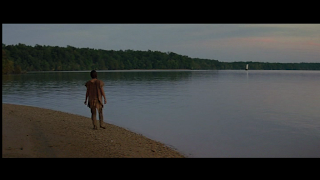 It is no surprise that Emmanuel Lubezki worked as the DP on The New World: the cinematography is beautiful, intense and captivating. There is simply no better way to glorify nature than the way Lubezki portrays the film's world. The musical score of the film is subtle and sometimes a bit weird. It left me cold sometimes - especially when it should have NOT done that.
 All in all, The New World is a calm and poetic film that suffers from being a little too uneven.